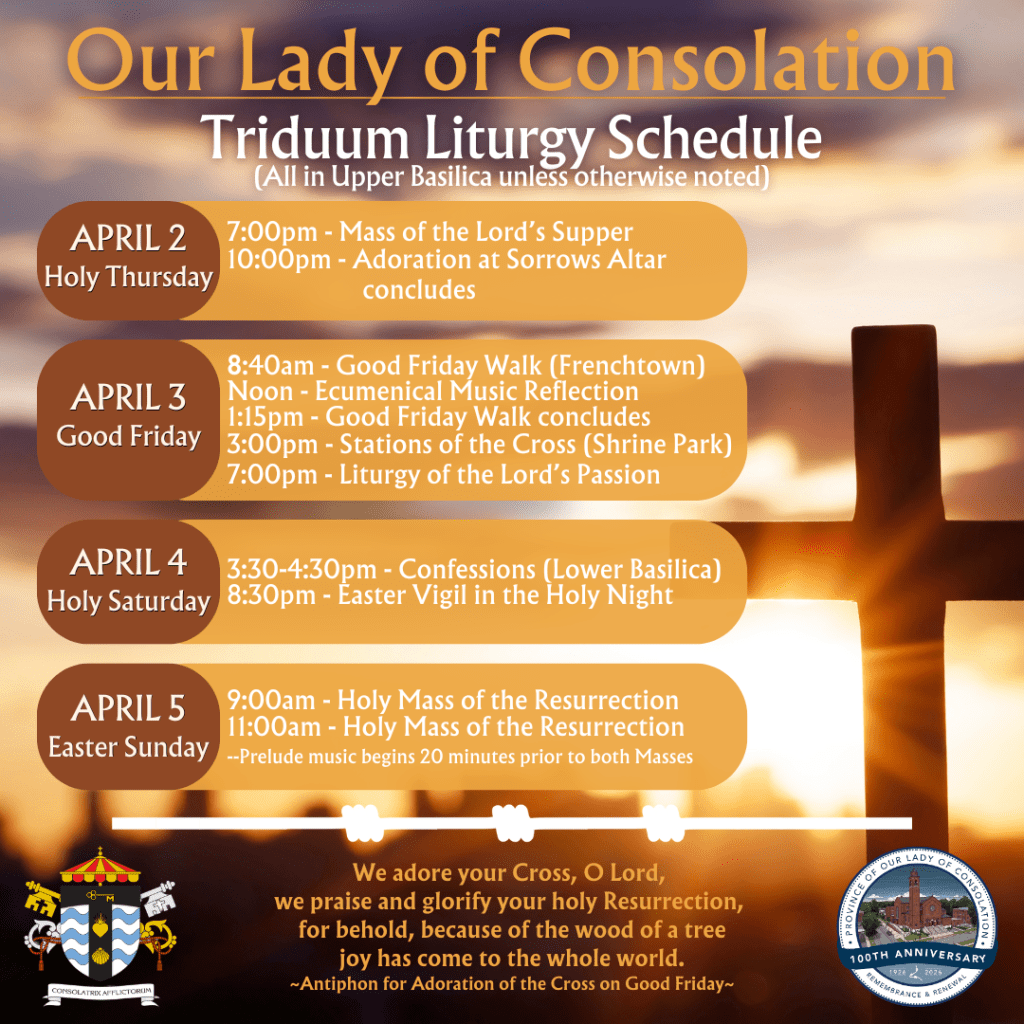
Holy Week Schedule
The three holiest days of the year—Holy Thursday through Easter Sunday—fall on April 2 through April 5. These three days known as the Triduum celebrate our Lord’s passion, death, and resurrection. These once-per-year celebrations hold so much richness and depth that one could spend a lifetime contemplating them, in fact, many saints have done that!
We all have much going on in life these days, but take some time out of your schedule to walk with our Lord during these three days. The only way to better understand what our Lord went through in these final hours of his earthly life is to walk it with him. Your faith will certainly be deepened by doing so.
Triduum Trivia
- The word triduum is pronounced “TREE-doo-oom” or “TRIH-doo-oom” with the emphasis on the first syllable.
- Triduum, means “three days,” and begins on Holy Thursday and runs through Easter Sunday. At first glance, that seems to be four days, however the days are counted by Jewish custom where the new day begins at sunset.
- Day 1 = Holy Thursday dusk to Good Friday dusk;
- Day 2 = Good Friday dusk to Holy Saturday dusk;
- Day 3 = Holy Saturday dusk to Easter Sunday dusk.
- The Triduum is actually one great liturgy spanning the three days. From the entrance antiphon on Holy Thursday until the end of the Easter Vigil, there is no final blessing or dismissal at any of the liturgies.
- Only one of each of the liturgies (Holy Thursday Mass, Good Friday liturgy, and Easter Vigil) is permitted to be celebrated in each parish church.
- No sacraments other than Reconciliation and Anointing of the Sick are permitted during the Triduum. Holy Communion may be brought to the sick at any hour on Holy Thursday and Good Friday. On Holy Saturday, communion is only permitted as viaticum (to the dying). Similarly, funeral Masses are not permitted. Funerals may only take place with a Liturgy of the Word.
- The Oil of the Sick, Oil of Catechumens, and Sacred Chrism which are used in the sacramental life of the parish (blessed by the bishop at the Chrism Mass) are brought forward on Holy Thursday night prior to the Mass.
- On Holy Thursday throughout the singing of the Gloria, the tower bells and the consecration bells ring. Then all bells fall silent until the Gloria during the Easter Vigil. During the consecration on Holy Thursday, a crotalus (wooden clacker) is used instead of the consecration bells.
- Good Friday is the only day in the liturgical year when Mass is not celebrated. Holy Communion at the Good Friday liturgy comes from hosts consecrated the previous evening at the Mass of the Lord’s Supper.
- On Good Friday, the cross to be adored stops at three locations in the church to be adored after the singing of an acclamation. All are then invited forward to adore the Holy Cross. Those meeting the usual conditions of sacramental confession (within 20 days before or after), reception of Holy Communion, and prayers for the intention of the Pope may receive a plenary indulgence for adoring the Holy Cross.
- The entirety of the Easter Vigil is to take place after dusk and before sunrise. It begins by lighting a “blazing fire” outside the church from which the paschal candle and incense for the liturgy are then lighted.
- Prior to lighting the paschal candle, the Greek letters Alpha (A) and Omega (Ω) and the current year are traced onto it. Five grains of incense are then inserted in the shape of a cross representing the five wounds of Christ.
- The newly lighted Paschal candle stops to be adored (and the light begins to spread throughout the darkened church) in the same three spots as the cross did on Good Friday thus showing the triumph of life over death.
- The Exsultet, a beautiful proclamation about the beauty, nobility, and purity of the candle (and therefore Christ), draws connections between the Passover of the Old and New Covenants. It is sung after the candle reaches the sanctuary. The Exsultet contains one of the most well-known paradoxical Christian phrases: “O truly necessary sin of Adam … O happy fault that earned [us] so great, so glorious a redeemer.”
- The Alleluia, which has not been sung since the day prior to Ash Wednesday, returns in a resplendant manner being sung three times accompanied by verses of Psalm 118.
- At the Paschal Vigil and on Easter Sunday, all present renew their baptismal promises as a sign of new life in Christ. Those meeting the usual conditions of sacramental confession (within 20 days before or after), reception of Holy Communion, and prayers for the intention of the Pope may receive a plenary indulgence for renewing their baptismal promises during these celebrations.
- Obligatory on Easter Sunday and optional each day through the Second Sunday of Easter, the sequence Victimae paschali laudes (Christians, Praise the Paschal Victim!) is sung between the alleluia and gospel. A sequence is a metrical hymn, generally non-scriptural, which provides a theological explanation or commentary on the feast of the day. Here is a brief summary of the Easter sequence:
- Stanza 1 calls us to praise Christ, our paschal victim.
- Stanzas 2 and 3 recall Christ’s redemptive work on the cross.
- Stanzas 4 & 5 are a dynamic dialogue between the apostles and Mary Magdalene delivering the news of the resurrection.
- Stanza 6 is an act of faith of the Christian community and is addressed to Christ.