Experience Hope & Healing Here
Since 1875 when the Statue of Our Lady of Consolation was carried from Saint Nicholas in Frenchtown to Carey, miraculous healings have occurred. Countless pilgrims and parishioners have been healed through the intercession of our Blessed Mother under the title of Our Lady of Consolation.
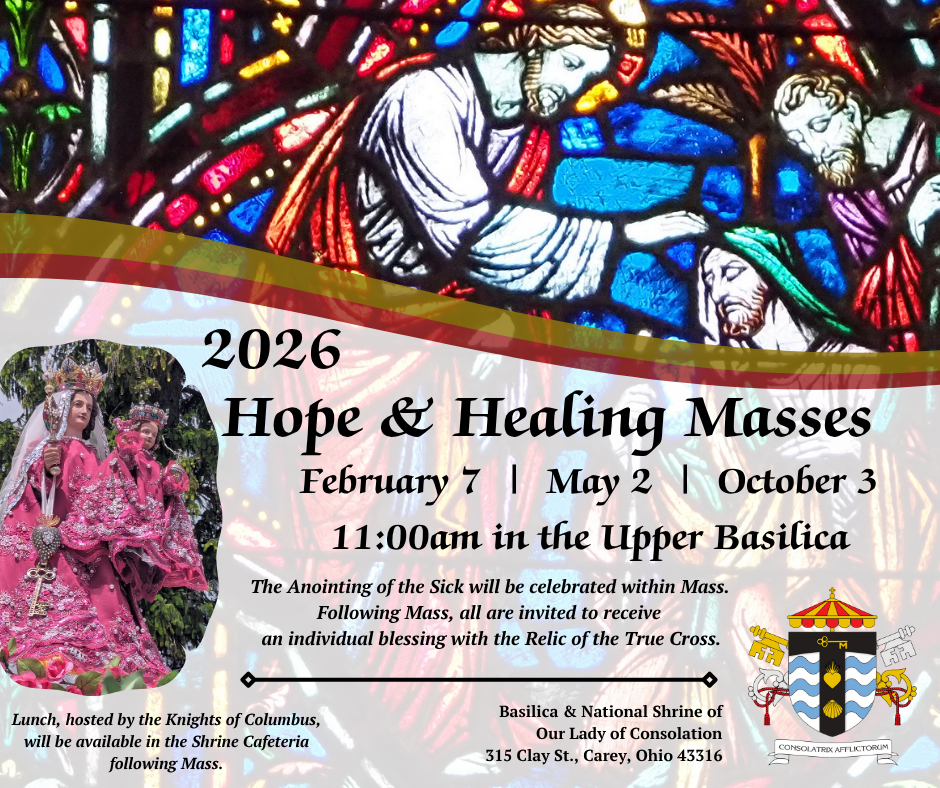
Entrusting ourselves to the divine power of our Blessed Mother’s Son, our Savior Jesus Christ, Our Lady of Consolation Shrine and the Franciscan Friars offer four healing Masses throughout the year. These usually occur on the first Saturdays of February, May, and October. A fourth healing Mass sometimes takes place on the Saturday within the Assumption Novena to Our Lady in August—be sure to check the Novena schedule to see if it is scheduled.
During Mass, the friars of Our Lady of Consolation will celebrate the Sacrament of the Anointing of the Sick. Those who are in need of healing from a serious illness of mind or body (see conditions), may come forward to be anointed. At the end of Mass, all present are welcome to come foward to receive a blessing with the Relic of the True Cross.
The Knights of Columbus Carey Council #1925 serves lunch in the Shrine Cafeteria from 11:30am to 1:30pm on the Saturdays when there is Healing Mass. A free-will donation of $8 for the lunch is suggested.
Our schedule for Healing Masses in 2026 can be found below.
About the Sacrament of Anointing of the Sick
The Lord himself offered much corporal and spiritual care for the sick and ordered his faithful to do the same; the Gospels bear ample witness and reveal the most powerful Sacrament of Anointing, which, have been instituted by Christ and announced in the Letter of Saint James, the Church thereafter was accustomed to celebrate with oil and the prayer of the Priests for the sake of her members; they commend those who are sick to the suffering and glorified Lord that he may lighten their suffering and save them (cf. James 5:14-16), indeed exhorting them to associate themselves with the Passion and Death of Christ (cf. Romans 8:17) and so contribute to the people of God. A seriously ill person needs God’s special grace, lest under pressing anxiety they be struck with dejection of soul, and, subject to temptations, perhaps forsake their very faith. For this reason Christ provides the powerful Sacrament of Anointing to his faithful laboring with sickness.
Faith is expressed in the Sacred Anointing, which is bound up with the prayer of faith (cf. James 5:15). This faith must first be stirred up both in the one who administers the Sacrament and especially in the one who receives it. For the sick person’s faith will save them, as will the faith of the Church, which looks to the Death and Resurrection of Christ from which the Sacrament draws its efficacy and foresees the future Kingdom, whose pledge is offered in the Sacraments.
The Order of the Anointing of the Sick and of their Pastoral Care: Introduction, nos. 5 and 7.
Who Can Receive the Sacrament?
The first condition for reception is that the person must be Catholic. The Sacrament of the Anointing of the Sick must not be trivialized and is not meant for common illnesses, broken bones, or conditions that are not life-threatening. “By every effort and diligence, this Sacred Anointing is to be conferred on the faithful who because of sickness, mental illness, or age are seriously ill. As to judging the gravity of the illness, it is enough that a prudent or probable judgment concerning it be made, any anxieties set aside, and, if the situation warrants, the advice of a doctor be considered.” (Introduction, 8) The following, from the Introduction, nos. 9-12, are conditions that warrant anointing.
- Those who suffer from serious illness or conditions of body or mind
- Those who, because of advanced age, have weakened strength, even if a serious illness is not apparent
- Those who already have been anointed but now suffer from a different illness or condition, or whose original illness has gotten worse
- Those who are to undergo surgery for a serious illness or condition
- Children who are seriously ill and can understand, respond to the sacrament with faith, and be comforted by it, may be anointed.