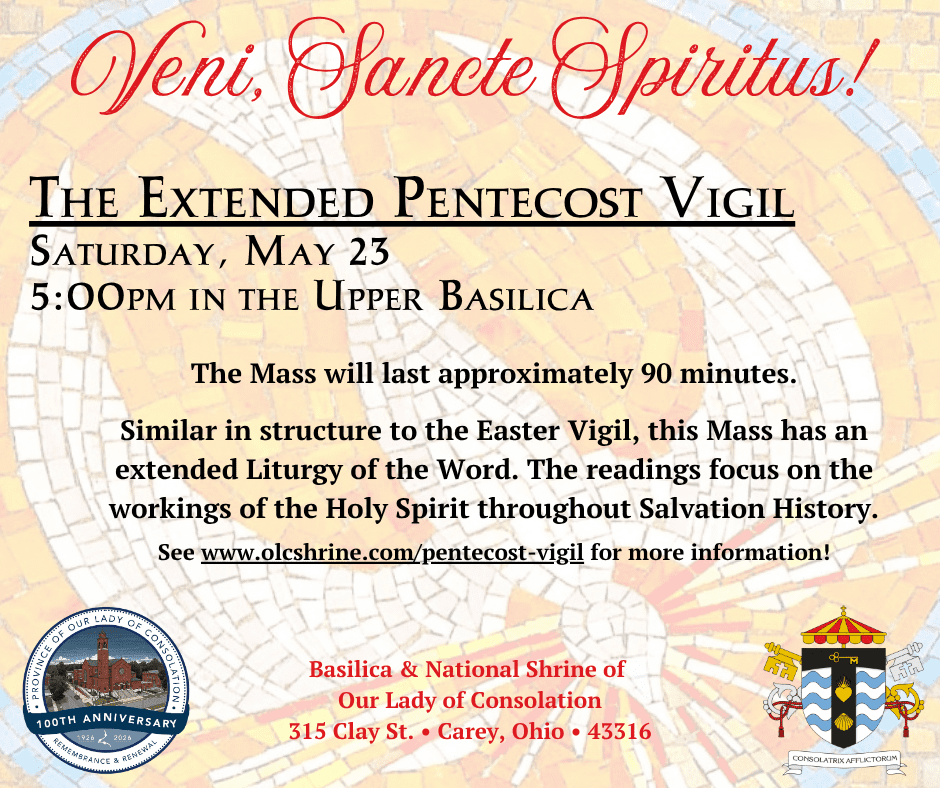
The Extended Pentecost Vigil
Dear Parishioners and Pilgrims,
Here we are on the first weekend of May which is already the Fifth Sunday of Easter—time flies! Of course, that means the conclusion of the Easter Season, the Solemnity of Pentecost, is quickly approaching on May 24. In preparation for this great feast, on Friday, May 15, the day after the traditional date of Ascension, we begin the Holy Spirit novena (you can find it online in many locations). These nine days between Ascension and Pentecost are known as the “proto-novena” (original novena). During these days, the Apostles, our Blessed Mother, and many others were in the upper room praying for the coming of the Paraclete (see Acts 1). On the final day of the novena, Saturday, May 23, we have the great opportunity to celebrate the Extended Vigil of Pentecost. This liturgy was originally drafted following the Council of Trent, but was not regularly used and eventually fell completely out of practice. It was revived in the most recent revision (2011) of the Roman Missal.
A brief history: the Pentecost Vigil arose from an early Church practice of celebrating the Sacrament of Baptism during vigils which preceded major feasts. There were three particular vigils when baptisms were regularly celebrated: Epiphany, Easter, and Pentecost. Each of these vigils prepared catechumens, as well as the faithful, for a powerful manifestation of the Lord:
- Jesus’s birth, revelation to the Gentiles, and baptism on Epiphany (this was the primary celebration in antiquity, rather than Christmas);
- Jesus’s Resurrection at Easter; and,
- God’s Spirit alive in the Church at Pentecost.
In the early Church, most of these baptisms would have been adults who would have also received First Communion and Confirmation at the same time. Now that infant baptism throughout the year is the norm, the Easter Vigil is generally the only time when adult baptism is celebrated. Pentecost now focuses mostly upon the outpouring of the Holy Spirit; thus, many dioceses choose to celebrate the Sacrament of Confirmation during liturgies as an opportunity for previously baptized adults to complete their Christian Initiation.
Pentecost is viewed in the calendar as the eighth (octave) and final Sunday of the Easter season. Eight, represents a new creation, perfection, and the day of eternity. This octave Sunday is therefore a fitting end to the celebration of the resurrection and the fulfillment of the promised sending of the Spirit. Thus, the Pentecost Vigil provides a suitable bookend to the first Mass of the Easter season: the Easter Vigil. However, unlike the Easter Vigil which is required to take place after dark on Holy Saturday, the Pentecost Vigil can be celebrated at any time on the evening before Pentecost.
The Extended Vigil of Pentecost is very similar in nature to the Easter Vigil. Following the Entrance Chant and the Penitential Act, the priest prays the Collect (Opening Prayer) and then addresses congregation with a brief instruction. All are then seated and the Liturgy of the Word begins. Akin to the Easter Vigil, there are multiple readings from the Old Testament. These readings highlight the working of the Holy Spirit throughout salvation history and the power of the Spirit to redeem humankind. In these four readings, we hear of the outpouring of the Spirit:
- overcoming sin (Genesis 11 – The Tower of Babel)
- giving the law and shaping the covenant with God’s people (Exodus 19 – The Ten Commandments on Mount Sinai)
- communicating true life through the prophets (Ezekiel 37 – The Dry Bones)
- turning the faithful into prophets (Joel 3 – the Spirit causing people to turn back to him).
After the proclamation of each reading, a responsorial psalm is sung: Psalm 33, Daniel 3 or Psalm 19, Psalm 107, and finally Psalm 104, respectively. Following the fourth psalm, the Gloria is sung and the Collect of Mass is prayed. Mass continues in the usual way with the reading of the Epistle from Romans, singing of the alleluia, and reading of the Gospel. The Gospel is from John 7 when Jesus and the Apostles are in Jerusalem for the Jewish feast of Pentecost (The Feast of Weeks). Christ proclaims that anybody who believes in him will receive the Spirit and have rivers of living water flowing within them. All in all, the Extended Vigil lasts about 90 minutes.
To close this article, it is fitting that Psalm 104 with its response of “Lord, send out your spirit and renew the face of the earth,” is the final psalm of the Vigil (and also the responsorial psalm on Pentecost Day). This same psalm is the first psalm sung at the Easter Vigil following the reading from Genesis 1—the creation of the world. By proclaiming this psalm first and last in the Easter season, the acts of creation, redemption, and re-creation are liturgically connected. The same spirit which hovered over the waters at creation, came to rest upon the Apostles and Mary. At our baptism and confirmation, that same Spirit came to dwell within us and makes us sharers in Christ’s priestly, prophetic, and kingly mission. May the coming of the Spirit this Pentecost fill our hearts with the fire of God’s love and send us out into the world to participate in the Lord’s renewing of the face of the earth.
Veni, Sancte Spiritus! Come, Holy Spirit!
Peace,
Anthony Gallina
Director of Music Ministries
View the worship aid for the Vigil here!